


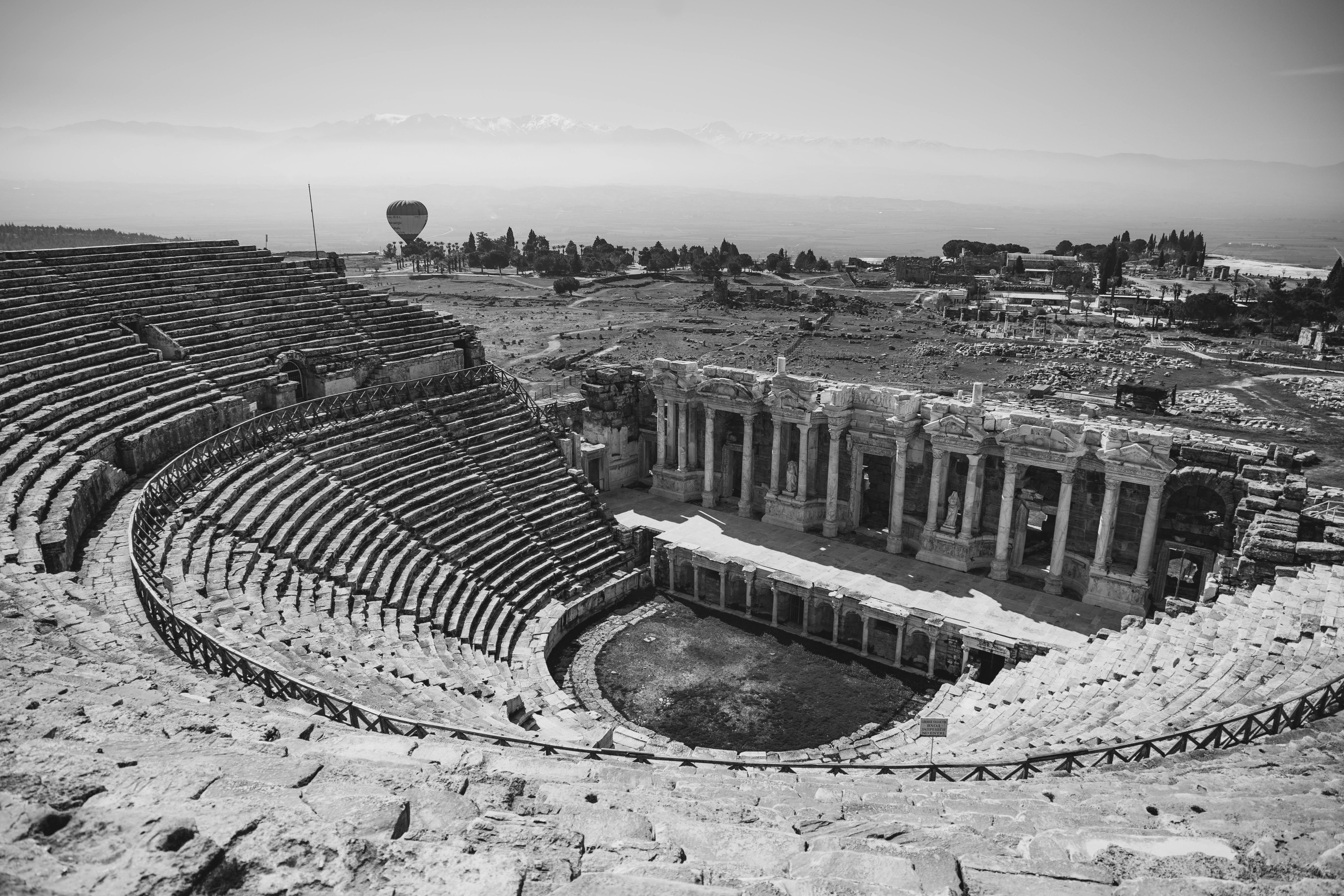
A theatre that “thinks” is not theatre that merely explains. It is a theatre that dares to ask questions without the adolescent impulse toward easy answers.
When we speak of a philosophical theatre, we don’t mean theatre that teaches or preaches, that simplifies complex problems into slogans, or that performs ideology under the banner of “owning the narrative.”
We mean theatre that opens a space of contemplative attention — a space in which the human condition is not simplistically moralized or reduced, but rather held, stretched, illuminated, and unsettled.
A philosophical theatre begins with a conviction:
that human experience is not reducible to identity, politics, or plot,
and that theatre is not simply entertainment or activism,
but a unique and sacred form of thinking and feeling through sequence.
It is thought that moves, sings, forgets itself, remembers differently, breaks, and doubles back in that eternal return of the human experience.
It is a thinking that happens in the relationship between what happens onstage and in the audience — through form, gesture, emotion, and and the contemplative placing of skilful silence. This relationship is cultivated not simply through the content of lines or the dimensions of plot.
Not Theatre About Ideas, But Theatre That Thinks
Too often, when theatre touches philosophy, it becomes didactic — as if the stage were a place to “raise awareness,” deliver arguments, or affirm a particular worldview.
But the great plays and musicals — Greek tragedy, Shakespeare, Chekhov, Beckett, Sondheim — they don’t tell us what to believe. Instead, as Sondheim wrote in “Sunday in the Park with George, they “gives us more to see.”
Great playwrights, writers, and composers stage meaningful forms of contradiction. They ask impossible questions.
These contrasts and contradictions might leave the intellect more uncertain, but they permit the possibility for human experience to become more aware — and as such, more alive.
They don’t attempt to resolve questions of meaning.
They enact new forms of meaning, perhaps as yet unknown.
This is not about turning theatre into a philosophy seminar.
It’s about reawakening the ancient, contemplative, and intellectual power to encounter the nuances and mysteries of being.
The Qualities of a Philosophical Theatre
A philosophical theatre is:
Metaphysically Ambitious
It asks: What is time? What is the self? What is suffering? What does it mean to be free?
Aesthetically Imaginative
It doesn’t apologize for beauty, form, or ambiguity. It embraces the diversity of structure as new ways of thinking and feeling.
Spiritually Open
Not reductively religious — but attuned to the human impulse toward transcendence, ritual, memory, silence, and presence.
Ambiguity-Positive
It resists the tyranny of clarity. It honors and plumbs the boundaries of possible experience, the uknown, and the unresolved.
Resistant to Propaganda
It does not lecture or align itself with ideological trends. It interrogates these trends and indeed everything beyond them — including itself.
Emotionally Precise
It uses the architecture of emotion, music, and gesture to bring the divergent felt-states of human experience into a deep alignment with form.
Examples of Philosophical Theatre in Action
Beckett’s Endgame: what does it mean to persist in a world stripped of meaning?
Sondheim’s Passion: is love a form of grace or delusion? Can possession ever be pure?
Sarah Ruhl’s Eurydice: can we re-enter the past? What does forgetting require?
Abhinavagupta’s rasa theory: how does emotion transcend the personal and become universal delight?
Artaud’s Theatre of Cruelty: can theatre shake the soul awake?
These are not plays about ideas. They are plays that are ideas themselves — embodied, scored, wept, spoken, broken, and sung.
Why Now?
Because we’re starving.
In a cultural moment saturated with literalism, ideological “fast food,” by an aesthetics of virtue-signaling and an economics of maximum profit, we believe theatre must return to an intention that is more ancient, sacred, and deeply relevant for our times.
This intention is…
Not to sell a particular message,
but to serve as expressions of revelation — similarly human and divine.
A philosophical theatre doesn’t just hold up a mirror to society.It holds up a mirror to being itself.
It reminds us that theatre, at its best, is not a tool for advocacy or escape.
It is a ritual of awakening—and a practice of truth.
If this resonates—if you’re a playwright, composer, thinker, or spectator who’s tired of being asked to applaud before you’ve had a chance to feel—welcome.
This is why the Future Sondheim Society exists.
Let’s bring thinking back to the stage. Let’s imagine a theatre that doesn’t explain itself—because it dares to be more than the sum of its themes.
Let’s build a philosophical theatre—together.
Would you like me to format this for a post in Substack, suggest tags and a title image, or generate a follow-up piece (“What We Don’t Mean by Philosophical Theatre”)?